Your story: Tell us a little about your journey as a winegrower. How did you get started, and what’s the story behind your vineyard or business?
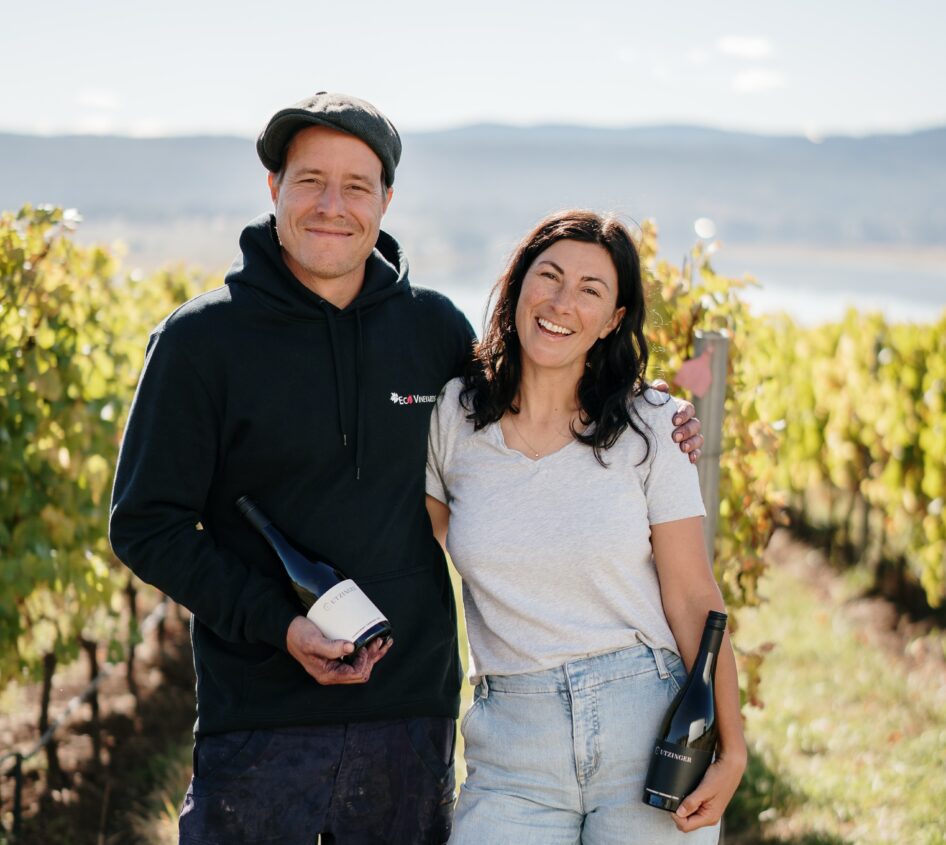
Matthias grew up in Switzerland with a small vineyard on his dad’s side of the family and wine on the dinner table. Although the vineyard was sold, his interest endured, leading to a winemaking apprenticeship, a degree in viticulture and oenology, and work around the world. Along the way, he met Lauren, a Tassie local with a zoology degree and extensive project management experience.
Together, we founded Utzinger Wines.
Our winery is in cool-climate northern lutruwita (Tasmania), on the western side of the Tamar Valley overlooking kanamaluka (Tamar River). We felt drawn to this place from our first visit.
We planted our vineyard in 2018 at 6,500 vines per hectare, with five Pinot Noir clones, six Chardonnay clones, Sauvignon Blanc and Syrah. Ferrous topsoil, ironstone gravel and dolerite pebbles over deep clay help shape our wines. In 2026, we added an experimental block of Petite Arvine, Scheurebe, Gewürztraminer, Riesling and the fungal-resistant crossing Divico.
As a certified organic vineyard and winery, we care for the whole ecosystem, creating habitat for beneficial invertebrates and native wildlife while allowing our terroir to speak.
We protect native grassland on ten percent of our property and have planted another ten percent with trees, understory and ground cover for wildlife. We believe high-quality fruit begins with good land stewardship. In the winery, minimal intervention lets our wines express the vineyard honestly.
We are vignerons. Our wines are grown – not made.
Why EcoVineyards? What inspired you to apply to become an EcoGrower? Was there something specific that influenced your decision, or had you previously attended an EcoVineyards session?
We had been following EcoVineyards for quite some time, even before the first sessions were held in Tasmania. Its holistic approach has always resonated with us. We’re continually looking for ways to improve our property, give it greater meaning and leave a legacy we can be proud of. Attending an information session reassured us that we had found a program that brought all that knowledge together in an accessible way. We’re looking forward to working with EcoVineyards and feel humbled to be welcomed into the wider EcoGrower community.
Your ecological journey: Was there a defining moment or catalyst that encouraged you to explore more ecologically driven viticultural practices?
After completing my winemaking apprenticeship, I took my first job at a biodynamic vineyard in southern France. That experience marked a turning point: I began to see myself not just as a winemaker, but as a grower, and to understand how deeply the finished wine is shaped by what happens in the vineyard. I felt part of a whole living system, like one musician in an orchestra, where the harmony depends on how all the different parts work together. That perspective stayed with me. When we established our own vineyard, we knew we wanted to work as respectfully with nature as possible.
This land is more than our workplace; it is our home, and it is also home to many other creatures that were here long before us. Caring for the vineyard means caring for that shared home, rather than focusing on the vines alone. We chose organic certification not because we see it as a silver bullet, but because it provides a clear framework and holds us accountable for the way we grow and make our wines. For us, it is a foundation to build on, rather than an endpoint.
Becoming an EcoGrower feels like a natural next step in that journey. We are especially looking forward to creating habitat for beneficial invertebrates, breaking up the vineyard monoculture and helping to restore natural balances. It is a way to put our respect for the wider living system into practice and continue developing the approach that first took root in France.
Your project: What are your initial project ideas, what would you like to achieve over the next year, and why is this important to you?
Over the next year, we would like to focus on two connected projects: strengthening natural pest control and establishing planned cover crops in our vineyard mid-rows. With EcoVineyards’ support, we hope to develop a habitat plan for beneficial insects, including lacewings, Trichogramma spp. and Dolichogenidea tasmanica, establish suitable host plants and install microbat nesting boxes. Alongside our continued use of pheromone-based controls, this will support our goal of eliminating insecticides entirely by the 2027/28 season.
For the cover-cropping project, our first priorities are a baseline soil-health and biodiversity assessment, species selection, an establishment plan and advice on suitable seeding equipment. We want flowering cover crops to provide food and habitat for beneficial insects while increasing soil carbon, supporting a more fungal-dominated soil ecosystem, improving winter water infiltration, reducing waterlogging and enhancing nitrogen fixation. Follow-up assessments in later years will help us understand what is working and guide our management.
Biodiversity on your property: Are you just beginning to explore biodiversity, or building on work already underway? Tell us a little about what you’re doing.
We’re building on work already underway. We have set aside ten percent of our property to preserve intact native grassland and planted a further ten percent with native trees, understory and ground cover to provide habitat for local wildlife.
For us, biodiversity is part of caring for the whole property, not just the vines. Over the past two years, we have also released beneficial insects on several occasions. We now want to build on this work by creating stronger connections between our existing habitats and the vineyard, using flowering cover crops, host plants for beneficial insects and microbat nesting boxes.
Your hidden superpower: What’s something others might not know about you, or a practice or idea you’d love to champion?
Our hidden superpower is the close attention we give to the vineyard every day. We spend a lot of time fine-tuning our canopy management, balancing airflow, crop levels and the leaf-to-fruit ratio to support healthy vines and minimise inputs wherever possible.
I’m particularly passionate about strengthening plant health through targeted foliar fertiliser applications and keeping copper use to a minimum. Spending each day in the vineyard, including doing the routine hands-on work, helps me notice changes and build a detailed understanding of conditions across the site. Those observations guide my decisions and allow me to adapt our spray program to the risks and conditions we’re seeing. For me, the everyday work is both a practical task and an opportunity to listen, learn and respond to what the vineyard needs.
The future of winegrowing: Where do you see grape growing heading in the future? Do you think there’s an urgency to change current practices? If so, why?
We see the future of winegrowing as a combination of careful observation, healthier vineyard ecosystems and a willingness to explore new varieties. At Utzinger Wines, organic certification, native habitat protection and our work with beneficial insects are all part of that approach. We believe there is an urgency to keep improving: healthy soils and functioning habitats take time to develop, and the choices we make now will shape the vineyard for years to come.
Every grower works within different conditions, so progress will look different on each property. For us, it means steadily reducing our reliance on inputs while maintaining fruit quality. One step we’re particularly excited about is the fungal-resistant vines we imported and planted last year, including Divico. Their disease resistance offers the potential to reduce fungicide use, complementing our efforts to minimise copper applications. We see them as an opportunity to learn, not a replacement for attentive vineyard management. The future we hope for is one where growers can share these experiences openly, combining practical knowledge with new possibilities to care for both their vineyards and the wider landscape.
Looking ahead: What else would you like to share with the broader EcoVineyards community, and what excites you about the future?
We’re excited to learn alongside other EcoGrowers and share what works, what doesn’t and what surprises us along the way. From creating habitat to exploring fungal-resistant varieties, we see plenty of opportunities to grow thoughtful, practical ideas together. Above all, we look forward to seeing our vineyard become a richer living landscape and leaving a legacy we can be proud of.